Monday, June 27, 2011

Without Words


Paul Knight’s works in the exhibition Without Words, curated by Kyla McFarlane, at Centre of Contemporary Photography, are photographs of couples embracing in bed. One member of each couple always has one eye open while the other sleeps. The photographs have a deep fold in the middle of the figures that feels like the crisp turned over sheet in a hotel room. This deep and precise fold contrasts the creamy crinkles of sexed up sheets and flesh. The fold has the effect of making the two figures seem anatomically one. The photographs are light and bright with details of wrinkles, hair and skin pores conveying a visceral sense of reality. There is a clear sense it is morning in these photos. These couples will not be able to stay like this for long, as the person with the eye open seems to know. These works depict an intimacy that is tender and familiar. They show a comfortable state of togetherness that will not require any awkward language about the state of their relationship when they wake.

However, the fold in the photo acts as a dark void. It suggests that moments in relationships that no longer have a need for words are as deep and relaxing and as comfortable as sleep.  In John Donne’s Song (circa 1600) a poem about leaving a lover for a time and trying to convince her not to worry about him—he concludes by saying:

But think that we
Are but turned aside to sleep;
They who one another keep
Alive, ne’er parted be.

Donne and Knight both allude to the solitary nature of sleep. Even when we sleep beside someone, we are in a state of internal isolation. The void created by the crease in Knight’s work suggests the depth of the individual’s unconscious that draws the two together in the first place.  It keeps them separate not only in sleep, but as individuals that don’t function as some sort of morphed unit once together. The couple who, as Donne says, ‘one another keep Alive’ must separate from each other in order to function in the world outside the bed. Though awake, they will need each other, be conscious and appreciative of each other in a way that they can’t be in sleep. It seems the member of each couple with their eye open might appreciate this. Though their dry stare to the ceiling or camera tells us they don’t need to like it and are perhaps envious of their partners deep comfort and sleepy solitude.
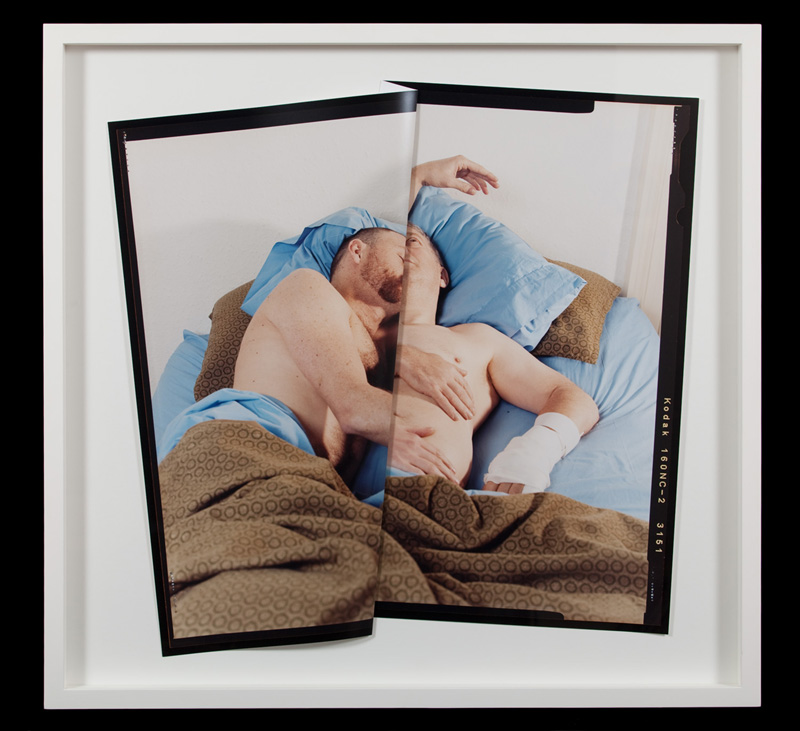

However, the crease in the photographs is unsettling.  The part we can’t see makes us curious of a “something missing” in this relationship. So while we might say it’s simply the parts that are unknowable of each other, it still doesn’t quell our desire as the viewer to iron it out. Make it more like the album cover for the soundtrack to Franco Zeffirelli's version of Romeo and Juliet. In psychoanalysis, language is used as the “talking cure”; words open up associations and understandings. The crease seems to imply that perhaps the closer and more comfortable these people become, the less they need to speak.  But things that maybe should be said, get lost down the same crevice that binds them. They risk seeing their partner as perhaps an extension of themselves rather than an individual. Freud writes ‘At the height of being in love the boundary between the ego and the object threaten to melt away’. If too much is left unsaid, it falls down the comfort crack. The deep and dark void becomes a form of waking sleep.

The viewer gazes at this scene with a self-conscious fascination of watching a moment that is intensely private. John Donne in The Sun Rising (circa 1600) admonishes the sun as a ‘saucy pedantic wretch’, who wakes up sleeping lovers. Like the sun in the poem, the viewer and photographer are an outside world that see the loving couple and speculate on the creases in their relationship.  The gaze of the viewer objectifies the couple as perhaps generic types; the old couple, the gay couple, the young couple, to differentiate the untitled works in our mind. So we get a sense that they have woken not only into the arms of a lover who they are close, connected but not co-joined; but also in front of a world of people like me who start finding words and categories for them “old”, “young”, “gay”, ”hairy”, “straight”, “male”, “female”. 

 
The crease, while seemingly menacing, could be about what can remain hidden. Perhaps it is hidden to protect something even more private then this morning moment. It can stay comfortably hidden between couples. It has to stay hidden from the taxonomic tendencies of the viewer. It may even stay hidden to the individual. They will tuck themselves in it at night and iron it out to face the world in the morning.

at CCP

Anna 


Thursday, June 23, 2011

Catching Trucks


Catching trucks is an a imaginative game played, on road trips, by putting out your hand and pretending to grab trucks that seem as though they could fit in your palm—a comparative size thanks to distance. A players hand frames the trucks between thumb and figures and then squishes it in a tight grip. The exhibition Catching Trucks, curated by Amita Kirpalani, at Gertrude Contemporary, focuses on artworks that block but also frame our vision just like the way a hand can clutch a truck.


Elizabeth Newman’s untitled consists of two large plywood structure made like schematic three dimensional windows and doors. They block the surrounding view but also offer passages; they frame an aspect of the view. They’re awkward and skinny in profile. This skinniness reminded me of Jude Law’s character in I Heart Huckabees, Brad Stand, saying ‘How am I not myself?’ They reference their surroundings but they are artworks that never seem to be themselves. In Catching Trucks there is a dichotomy between screens and passages; blocks and thoroughfares. Liminal spaces are described by their concealment. The translucent screens onto which pleasures are projected lose their opaque significances.
  

Numerous collages by Sean Bailey render desire and pleasure in small glimpses of images which seduce the eye in ways a complete image cannot. His artworks are collages where blotches of flat opaque pigment are painted over printed photographs which are only visible at the very margins of the image. Nothing of the action of these images can be seen. It is obscured by the blotches leaving only unrecognisable suggestions. Yet an intrigue is sparked by these vague edges. The blotches are a murky dreary colour and an ugly shape. They have a spilt quality which suggests that what was in the printed picture was more interesting to look at. But, of course, the blotch is the picture. It is clear that the buried content is more banal than its suppression requires.


Green Structure (2011) by Richard Maloy, installed in the front gallery, is a lot like the apple in The Listening Room (1952) by René Magritte. It is granny smith green and its brimming proportions fill the space of the gallery. When we first enter the gallery the view is very similar to The Listening Room—we see a square room with the window on the left which is filled with something big and green. There is one important distinction however; Maloy’s room cannot be seen as a full composition—in the same way as Magritte’s painting. Magritte puts the viewer in a pseudo-space in the logic of the painting to enable them to see the view. This view contradicts the emotions of the artwork; the viewer remains in the comfort of space in order for the artwork to render a cramped feeling. However, with Green Structure the viewer is stuffed-in with the artwork and it evokes actual claustrophobia rather than a metaphor. Like the magnitude of a natural disaster, we are only ever able to see parts of this huge object and, like in Bailey’s work; we experience the thrill of the limits of what can be seen.


This exhibition snatches the straightforwardness of reality from before our eyes. Lisa Oppenheim’s slide show The Sun is Always Setting Somewhere (2006) is more like the screen than the projection. A hand holding a photographic print of a sunset extends into each frame which is also of a sunset so that the two images match up. The sun, at the end of the day, gazes back at the viewer from the horizon. A photograph held against the blazing sun would be dark with a radiating light aura beyond its borders but the camera’s limitations condense these tones to the point where the image looks coherent. The sun’s gaze penetrates the photographed photographic image. Likewise, the six films of Ideal Demonstration (1972) by Peter Kennedy use a screen to reveal as well as conceal. In one Kennedy attaches sheets of transparent acetate between his face and the camera, one by one, until his image disappears. In another his body’s bright image burns a trace on the film after he has moved. In a third he opens and closes his eyes. Kennedy’s film reveals a subjective vision which is a product of a state of mind. While the screen can screen our view it is also the media onto which our view is screened. Can it be that we see and also see what we see? We project our fantasies onto our visual field but we censor them from ourselves behind a series of stereotype images.


The hand seen holding up the sunset photographs in The Sun is Always Setting Somewhere is like Green Structure in that it demonstrates our inability to visually assimilate our body. In Oppenheim’s collage the hand poetically belongs to the viewer but it doesn’t meet our arm. While in Maloy’s work the view is felt with the body more strongly than it is seen. The point of view implicitly laid-out in each of these artworks is strangely missing even though it is right under our noses.


At Gertrude Contemporary
Tim

Saturday, June 11, 2011

The adventures of an orange vinyl chair


Imagine your primary school teacher’s orange vinyl chair falling through the air. Your teacher is not on it anymore. The chair has been thrown out of a plane by sky divers and they are filming it. It doesn’t twirl around like a crazy out of control object hurling to its doom. It just falls gracefully upright, like someone could still sit on it. This work, Matthew Greaves’ Untitled (Stuff Jump) at tcb gallery, evokes  the fleeting feeling of a fall in a dream.  The orange chair in white fluffy clouds and blue sky reminds us of a Rene Magritte painting.  Like Magritte’s cloud wallpaper with big toiletries, moon in a tree or train coming out of a chimney, there is a gentle curiosity that makes us ponder the hows and whys of how it came to be there.  There is something about the ordinary becoming extraordinary that fills us with hope. 


This chair has probably been sat on, without love or comfort, in portable classrooms watching Behind the News or poster presentations on amphibians. Its life as a chair has been practical and no frills and it has done its job and there’s not much more a chair should expect in this life. But this moment, this moment post function and before destruction; this is the terrifying joy of being completely free and useless.  We don’t see the destruction of the chair.  It fades on down through the clouds. As we anthropomorphise the plain and functional chair, we perhaps find this chair’s end as unimaginable as our own. 


It is sometimes hard to remember that the chair is falling. It seems attached to something. An invisible string attached to the plane,  or perhaps a ceiling of sorts.  Of course we did our poster presentation on the sky and know there is nothing to attach this chair to. No puppeteer or secret string that will pull it up when it gets too close to the ground.  So you start to imagine that the chair is not falling at all. It is flying. 


The work is a fantasy of escape reminiscent of Enid Blyton. In childhood these adventures of flying chairs give the child an opportunity for vicarious heroic adventures.  The primary school teacher’s chair’s escape divulges the secret desires of adults to escape on heroic adventures too. Though as adults, flying may seem too much like falling to risk it.  This flying chair, with its life before and its life after this moment alluded to by its nature and circumstance, is a celestial salute to the present - with all its fear and beauty.


On at tcb gallery until 25th of June

 Anna

Wednesday, June 1, 2011

Jesús Malverde, Santa Muerte and the Virgin of Guadalupe


Mexicans are tough. The Mi Casa Su Casa exhibition at No Vacancy gallery shows why. It has stencil art of smashed up cars, wrestling masks in orange juice ads, skeletons singing and stigmata bleeding Christ holograms that turn into Pope John Paul. It is tough but it is bright and it is festive and there are doilies and embroidery and colourful cowboy shirts and beer bottles with flowers in them at the altar of the patron saint of narcotics. The smashed up cars are displayed on a sunny roller-brush background. One death skeleton has the virgin of Guadalupe’s crown being placed by angels on his head, while he is surrounded by American eagle body builders and fake tanned pole dancers. We see how Mexican culture not only lets Death in but laughs at the arrogance or absurdity of ever trying to keep him out. 


Oscar Reyes and Watchavato show us the side of Mexico that Octavio Paz describes as ‘the hubbub of a fiesta night our voices explode into brilliant lights, and life and death mingle together’. In his essay The Labyrinth of Solitude, Paz contrasts a North American preoccupation with purity, health and longevity with the Mexican belief in communion and fiesta. Paz puts it that ‘there is no health without contact. Tlazoltetl, the Aztec goddess of filth and fecundity, of earthly and human moods, was also the goddess of steam baths, sexual love and confession’. Paz suggests that the disinfected North Americans live in a perpetual denial of filth that manifests in a ‘sadism underlying all relationships imposed by a doctrine of aseptic moral purity’. Reyes’ collages juxtapose the tropes of North American advertising (that focus on the individuals desire to be “cleansed” or “improved”) with the chaos of communal catharsis in the fiesta.


Throughout the exhibition we see an embrace of destruction as a part of life. The skeleton Santa Muerte (Saint Death) playing on a guitar, is printed on embroidered roses and mounted in a pretty white frame. The image evokes a reverence and humor in response to the inevitability of not just our actual death but also failure, sadness, life’s frequent banality. The embroidery and detail evoke a warm domesticity that makes us even more comfortable with a singing death. We sense the presence of a mother.


When we look to the side, we see her. An altar for the Virgin of Guadalupe with a sculpture of her surrounded by lights, flowers, pictures of her that sparkle and a little diorama of her rose bush miracle in a clear box. It’s beautiful and excessive and we feel how much this image is adored. The dark skinned Virgin of Guadalupe is symbolic of the fusion of Spanish and Aztec cultures that was born from colonial violence. This is the ever loving mother who forgives. Sin is not to be denied but rather confessed. 


Opposite the shrine to the Virgin is the shrine to Jesús Malverde—the patron saint of narcotics. He is prayed to, to help conceal drugs across borders. Watchavato has made wallpaper behind the shrine of Malverde’s image on American style bank notes. This evokes the capitalist conundrum of supply and demand in terms of North American’s participation in this drug trade. Next to this is a work commissioned by a drug lord, including skate boards with Malverde’s image (among others) airbrushed on them. The druglord was killed before he was able to give them to his sons. 


So amongst all the colour and festivity of this show there is a confrontation with destruction. Amongst the flowers, the girls, the cars and the ever loving mothers, you get the feeling that death is avowed and homely.


Thursday, May 19, 2011

A Party at Balfron Tower


A crowd of people storm up stadium steps on Sunday and on Monday the steps are deserted. Just the railings and the concrete remain. People whirl around a turquoise dance floor and have blurry memories of a girl’s hair and an amber light that haloed her in the morning.  Simon Terrill’s exhibition Phantom at Sutton gallery explores the nature of people, place and time in photography.  Terrill is able to capture moments of great human frenzy and excitement and then the stillness and consistency of the spaces they inhabit. These joyous and ephemeral moments become memories that will morph and change as they are remembered. However, the concrete stays still and objective and (like an Aldous Huxley nightmare) can be wiped clean of today’s individuals and gets ready for the next batch. Balfron Tower is photographic mural of the dark, monolith housing estate in which Terrill lives. Balfron Tower had been designed by Erno Goldfinger as part of a post war vision of a vertical London. In the process of constructing this photograph, Terrill enables the residents of the building to make their mark on the place they live their life. By photographing it, Terrill makes the human moments, however small and quirky, rival the longevity of the steel and cement.

The residents of Balfron Tower are out on their balconies or on the green lawn in front of the building celebrating with coloured lights, potplants and streamers and cups of tea and TVs on and holding hands and making joyous circles. The building has been flood lit and has been photographed from a distance so all of the residents seem tiny. It feels similar to looking at a model railway where we are initially awed by the size and scale of the construction and then on looking more closely start to marvel at the detail. We get the perspective of perhaps some omnipotent being that sees all and can peer into any apartment we choose or perhaps we are just a little voyeur who lives in their own big concrete slab across the street.  

The cold and blocky architecture of the Brutalism movement in the 1950s – 70s was founded on a socialist utopian ideology. Erno Goldfinger was part of this movement who wanted to create highly functional, uncompromising, antibourgeois buildings that would be affordable and honest. However, the great grey masses tended to look rather unfriendly and miserable and would stick out from the rest of the urban environment like stark, alien fortresses.  We see in Balfron Towers these small, dark bridges across to the lift tower on each floor.  These bridges have an ominous narrowness in comparison to the bulk of the building. Like a gangplank of a pirate ship, they suggest limited ways to get out once you’re in. The building was said to evoke ‘a delicate sense of terror’.

Terrill picks up on the terror. The floodlit building against the dark sky with the small celebrating figures throughout it fills us with an existential chill. When we start to look at the little groups we see one has written the word disco in lights on their balcony, others have suspended a little donkey piñata between the floors with colourful streamers. All these tiny people, with their tiny expressions of joy or laughter seem so vulnerable. This architecture does not encourage individuals to express themselves outwardly. So while these residents may be close to their neighbours in proximity, they are encouraged to keep personal expression to the confines of their apartment. The building protects these humans from really having to live together and accept diversity.


 By constructing these joyous crowd scenes, Terrill comments on the original utopian ideals of the architects. Utopias rely on a sense of a communal whole that puts aside the needs for individual expression. The little individuals contrast their expressions of happiness with the giant looming ideals of promised freedom and equality that the building evokes. We know this moment of togetherness and community will end like a New Years Eve countdown and they will kiss and say goodnight and wake up to concrete and the gangplanks down to the lifts. However, this does not have to end so melancholically. The project itself was very uplifting for the residents of the building and they got a great deal of joy and empowerment from this event.

Anna 


at Sutton Gallery

Tuesday, May 10, 2011

Deborah White's Ghosts


Deborah White's installation Ghosts of the near future is a surreal submariner’s pet shop that sets out to discuss issues of climate change and environmental dystopias. There are six pretty bird cages with a vivid green almost toxic coloured video projection shining through them. In the cages fish/humans with animal masks swim seemingly up to the viewer, perhaps looking for a buyer or perhaps just looking out of their cage/fish bowl because they are trapped. Behind the cages we see a video projection of a bay window and a fresh green garden. Through the window we initially see a young girl/woman with tight blue pants and a fresh white shirt chasing butterflies with a red butterfly net. We realise that we too are enclosed and looking out just as the swimming rabbit, horse, duck, monkey and cat are. The cages make the joyful butterfly catching more sinister.

This artwork explores our desire to own and collect. It challenges the notion that as we gather more things, and guild our own cages we somehow advance. The principal of collecting centers on a lack. It is about taking pleasure in the infinite; the impossibility of completion that makes collections so stimulating. On his death bed, novelist and passionate butterfly collector Vladimir Nabakov was said to say ‘that [a] certain butterfly was already on the wing’ and he no longer hoped that he would live to pursue it again. The collection stops when the collector stops, it must remain incomplete in order to inspire desire in life. Nabakov wrote his famous novel Lolita while on butterfly collecting expedition.


The image we stumble upon in the gallery is similar to Nabakov’s famous narrator Humbert (a sexual predator) seeing 'a burst of greenery' before first meeting 'this Lolita, my Lolita'. The desire to catch something or someone, own it in the way Humbert longs for ownership of Lolita can never be totally realised without a fear for its escape or loss. The insidious gaze of the collector turns the innocent green of the garden to the acidic green of waste. However, the ephemeral qualities of girl and butterfly cannot be caged or preserved. The sad, masked creatures that have been caught and caged, allude to the paradox of collecting/owning. Like touching a butterfly’s wings, once you claim to have it, the elusive beauty will be forever compromised.  

In the video, the scene of the youthful girl fades and returns as an image of the girl now a woman with glasses, reading inside. While she is still the object of our gaze, we realise she has put down her butterfly net, come inside a cage of her own and has started a book collection. She reads Australian writer George Turner’s 1988 The Sea and Summer, which opens with a couple rowing between the drowned skyscrapers of Melbourne CBD as a result of climate change. As the video goes on, the pile of book increases. All the books seem to deal with the prospect of environmental disaster. The bay window outside starts to fill with the same toxic green, the caged creatures start to appear beside the reading, aging woman. The books could symbolise a pile of accumulated knowledge on the grave fears for the environment. Ironically, the endless pursuits of book-collectors contribute to this destruction. This work seems to warn us of the destruction in collecting. The more we want may result in the more we lose.


Saturday, April 30, 2011

Maurizio Cattelan's Donkey


Dark, horror of darkness
My darkness, drowning, swirling around me
Crashing wave on wave – unspeakable, irresistible
Headwind, fatal harbor! Oh again,
The misery, all at once, over and over
The stabbing daggers, stab of memory
Raking me insane
‘Oedipus The King’ – Sophocles

There is a taxidermised donkey sitting forlornly facing the corner of the Museum of Contemporary Art San Diego in La Jolla. It is an artwork by Italian artist Maurizio Cattelan in the Mexico Expected/Unexpected exhibition. The donkey doesn’t face the panorama ocean views worthy of any Californian postcard.  He does not stand on his four legs as one might expect but rather sits with his legs spread apart and his ‘arms’ dropped down in front of him like a sulking child. This anthropomorphised donkey has a thin yellow ridge down his back that meets another line at his bottom to form a cross. This beast of burden is bearing his cross to the view of the ocean. As a viewer, you are initially struck by the sadness of this image of the burdened animal who can never see the picturesque scene at his back.

Donkeys are characterised by their hard work with little status and prestige as an animal. Unlike a horse, they are considered ugly, stupid, stubborn and lazy. The biblical donkeys that take pregnant Mary into Bethlehem at Christmas and Jesus to Jerusalem on Palm Sunday emphasise the miracle associated with a saviour that rides on such a humble animal. These donkeys plod along to the stable of the birth and the parade before the death.  That cross on the donkey’s back facing the view, creates a contrast we are familiar with from these stories.


Other donkeys in literature are characterised as pessimists. They are thinkers who know too much and think that nothing can be done. The cynical Benjamin from ‘Animal Farm’ knows the revolution won’t work and that nothing will ever change except those who hold power in their hands. Eyeore from ‘Winnie the Pooh’ who: “thought sadly to himself ‘why?’ and sometimes he thought ‘wherefore?’ and sometimes didn’t know what he was thinking about”. Francisco Goya’s donkeys in ‘Los Caprichos’ are dressed up as men of the Enlightenment. In comic and satiric poses they are having their pictures painted by monkeys, riding on men’s backs and researching their genealogy in books about horses. While one might simply want to tell these allegorical donkeys that there cynicism perpetuates their misery. They do nothing to help change the situation themselves. If only they could just turn around and see the world is a beautiful place. We know that this advice might work well on Oprah, but does little to address why one would want to stare at the corner in the first place.


Firstly, it may be argued the donkey doesn’t even know what is behind him. He is like the prisoners in Plato’s allegorical cave who watch the mere shadows of life on the wall. They believe that their experience of those shadows is reality. They are totally unaware of the existence of the sun lit real reality just outside. They interpret and make meaning of the shadows though they ultimately offer nothing but dark projections. The chained prisoners cannot know what they cannot know. 


In Freudian terms, the view of the wall may be acting as a foil—replacing what could be seen and understood. This could be seen as the nature of repression. The donkey represents the unconscious. In order to see the view he projects himself—his ego—onto the wall, which is, after all, facing the view. He thinks of himself as the wall. The wall becomes a screen by which the beach, the surf, the birds flying past can be seen as reality. You must face the cinema screen not the projector. If he were to turn around he would not see sunshine; he would not see anything. He would no longer have access to his mode of vision. The perceptual impulses of blue, turquoise and gold could not be seen by him. 


Truth is often put on a pedestal; painted in terms of sunshine and happy revelation to be sought after at all costs. We can just look to characters like Oedipus to see how this metaphorical ocean view of truth may want to make you stab your eyes out or at least just face the corner. It is undoubtable that we all continue to face certain corners of our minds. These are restricted areas that are used as a form of self preservation and protection. To turn around and face the view might make you aware of being a taxidermised donkey.


Another way to consider the work is that the donkey is fully aware of the view behind him and quite enjoys the corner. Like the thrill one may get from saving money for something special, but nothing is ever special enough to supersede the special joy of saving. The control and the saving is the best bit. Dieters know more than anyone that satisfaction of going without. Facing the corner on the chocolate cake and eagerly awaiting reward in the form of a loss on the scales.

Satisfaction can be achieved through denial. The truth can be a scary and confronting prospect that perhaps takes on the mask of a Californian sunset. We face the corner like the donkey to feel a sort of arbitrary control over ourselves and our existence. There is nothing like watching a beautiful sunset day in day out to serve as a well loved metaphor of time passing and how our own aging bodies will eventually give way like our taxidermised donkey friend. No wonder he faces the corner. 

Tim Alves & Anna Newbold